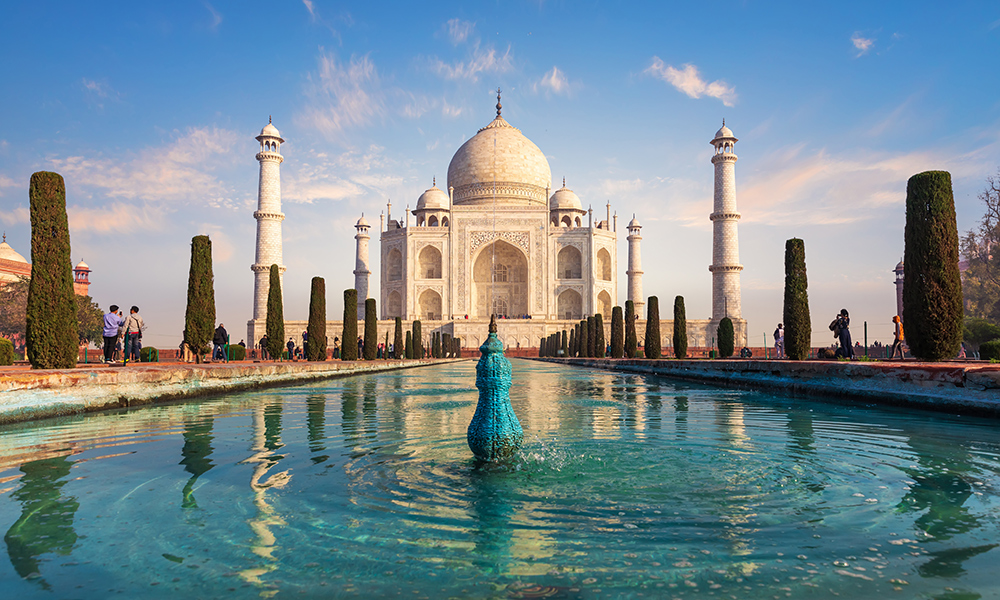
If this is your first time at the Taj Mahal, here is the plan in four lines. Book your ticket online from the official portal, visit any day except Friday, arrive before the gates open, and keep the morning free for the complex itself. A foreign visitor pays ₹1,100 to enter plus an optional ₹200 for the main mausoleum. The monument opens 30 minutes before sunrise and closes 30 minutes before sunset. Agra is about 200 km from Delhi, so most people either start very early or stay one night.
The sections below follow the order in which you will actually need the information: what the Taj is, when to go, what it costs, how to get there, what to carry, what to wear, what to see nearby, and how to move around Agra.
Quick facts for first-time visitors
Where |
Agra, Uttar Pradesh, on the bank of the Yamuna river |
Closed on |
Every Friday (general visitors) |
Opens / closes |
30 min before sunrise / 30 min before sunset |
Entry fee (foreign) |
₹1,100, plus ₹200 for the main mausoleum |
Entry fee (Indian / OCI) |
₹50, plus ₹200 for the main mausoleum |
Children |
Under 15 enter free |
Entry gates |
East and West (South gate is exit-only) |
Allow |
2–3 hours inside the complex |
Photography |
Allowed outdoors; banned inside the main mausoleum |
A short history of the Taj Mahal
The Taj Mahal is a tomb, and a grief-driven one. The Mughal emperor Shah Jahan commissioned it after his wife Mumtaz Mahal died in June 1631 while giving birth to their 14th child. Work began in 1632. The main mausoleum was largely finished by about 1648, and the surrounding mosque, guest house, gateway and gardens followed around 1653. Shah Jahan himself is buried beside her.
The project employed thousands of artisans, with a figure of around 20,000 often cited, working under a board of architects led by the court architect Ustad Ahmad Lahauri. UNESCO inscribed the Taj Mahal as a World Heritage Site in 1983, describing it as one of the universally admired masterpieces of the world's heritage. If you want the stories behind the stones, an informed guide is the best investment you can make (more on guides below).
Taj Mahal architecture: what to look for
You don't need an architecture degree to enjoy the Taj, but a few details make the walk far richer.
- The Charbagh garden. The complex follows the Persian four-part garden plan, divided by water channels. Walk it slowly rather than rushing to the platform.
- The central dome and the four minarets. The minarets are built slightly outward-leaning, a design choice that is usually explained as protecting the tomb if one ever fell. The main chamber is an octagon.
- Pietra dura inlay. Look closely at the flowers and vines around the arches. They are cut stone set into white marble, and the detail is best seen in low, angled light.
- Calligraphy. The Quranic inscriptions around the main arch are designed so that letters appear the same size from the ground, even though the upper ones are larger.
- The cenotaphs. Inside the main chamber you see the decorated cenotaphs of Mumtaz Mahal and Shah Jahan. The actual graves are on a lower level.
- Symmetry, with one exception. Almost everything is mirrored, including the mosque and its matching building. Shah Jahan's cenotaph is the notable off-centre element.
The overall style blends Persian, Islamic and Indian traditions, which is why it is often called the finest example of Mughal architecture.
Best time to visit the Taj Mahal
Best time of day: sunrise. It is cooler, calmer and the light is soft on the marble. Late afternoon is the second choice. Midday is the hottest and most crowded stretch.
Best months: October to March. Pleasant weather, though it is also peak season. Daytime highs in Agra in November are around 28–29°C with nights near 13°C. December and January can bring dense morning fog that hides the monument, so keep one spare day in your plan. February and March often give the best balance of clear skies and manageable crowds.
April to June is very hot, so go at opening time and leave by mid-morning. July to September is monsoon season, with fewer visitors, green gardens and the occasional downpour. For a broader seasonal view, see our India climate guide.
Crowds: weekends and public holidays are busiest. Because the Taj is closed on Fridays, Thursdays and Saturdays can feel heavier than you expect.
Taj Mahal opening hours
The official rule is simple: the gates open 30 minutes before sunrise and close 30 minutes before sunset. Ticket counters open one hour before sunrise and stop selling 45 minutes before sunset. Use this table for planning (approximate, calculated from monthly Agra sunrise and sunset times) and confirm for your exact date.
Month |
Gates open (approx.) |
Gates close (approx.) |
January |
6:40 AM |
5:16 PM |
February |
6:26 AM |
5:40 PM |
March |
5:59 AM |
5:57 PM |
April |
5:25 AM |
6:12 PM |
May |
5:01 AM |
6:29 PM |
June |
4:54 AM |
6:44 PM |
July |
5:03 AM |
6:45 PM |
August |
5:11 AM |
6:36 PM |
September |
5:30 AM |
5:58 PM |
October |
5:48 AM |
5:21 PM |
November |
6:09 AM |
4:58 PM |
December |
6:31 AM |
4:57 PM |
The Taj Mahal is closed every Friday for general visitors. There is also a separate full-moon night viewing.
Taj Mahal entry fees and ticket booking
The fees below are inclusive of the ASI and Agra Development Authority components.
Visitor type |
Entry fee |
Main mausoleum (optional) |
Total with mausoleum |
Foreign tourist |
₹1,100 |
+ ₹200 |
₹1,300 |
SAARC and BIMSTEC citizens |
₹540 |
+ ₹200 |
₹740 |
Indian citizen / OCI cardholder |
₹50 |
+ ₹200 |
₹250 |
Children under 15 |
Free |
— |
— |
Check a live exchange rate for USD, GBP or EUR on the day you book. Fees can be revised.
Is the mausoleum ticket worth it? For most first-timers, yes. It takes you onto the platform and into the central chamber. Just remember that photography is not allowed inside.
What is included for foreign visitors. Per the official site, foreign (and SAARC/BIMSTEC) ticket holders receive shoe covers, a half-litre bottle of water, a tourist map of Agra, and free battery-bus and golf-cart rides from the parking area to the gate.
How to book Taj Mahal tickets
- Book online through the official ASI ticketing portal, which is linked from tajmahal.gov.in. Online bookings carry a small discount (₹50 per foreign ticket, ₹5 per Indian ticket per the official site).
- Double-check the web address before you pay. Copycat booking sites exist.
- Or buy at the gate. Counters at both the East and West gates sell tickets from one hour before sunrise to 45 minutes before sunset, with separate queues for foreign and domestic visitors.
- Carry government-issued photo ID along with your ticket.
Booking through a tour operator? Ask whether the Taj ticket is included or paid on the day, and which entry gate your guide will use.
How to reach the Taj Mahal
Agra sits on the classic Golden Triangle between Delhi and Jaipur, about 200 km from Delhi.
- By road. The Yamuna Expressway and the older highway link Delhi and Agra. Expect roughly three to four hours by car depending on traffic. A private car with a driver is the most flexible option, particularly for a sunrise start.
- By train. Agra Cantonment is the main station. The official site lists the Gatimaan Express, Shatabdi, Rajdhani and Taj Express among the main Delhi–Agra services. Book through IRCTC and check timetables for your date.
- By air. Agra has an airport (Kheria), but commercial flights are limited and seasonal, so most visitors fly into Delhi and continue by road or rail. Check current schedules before relying on it.
- By bus. Interstate bus terminals at Idgah and ISBT serve Agra. They are the budget option and the least convenient for a sunrise visit.
Travelling from abroad? Sort your visa early. See our India visa guide.
Local transportation in Agra
Once you are in the city, getting to the Taj is straightforward.
- Private car with driver: the easiest option, especially for early starts and when combining several sights in a day.
- Prepaid taxi, auto-rickshaw or cycle-rickshaw: all are available from the main railway station, according to the Agra district website. Agree the fare before you start unless it's prepaid.
- The last stretch: polluting vehicles aren't allowed within about 500 metres of the monument. Cars drop you at designated parking (Shilpgram for the East Gate, Amrood ka Teela for the West Gate), and battery buses and golf carts cover the remaining distance.
Agra travel tips on timing: allow extra time for security and the walk from parking, particularly in peak season. If you stay in a hotel near the East Gate, you can often reach the entry area quickly.
Which gate should you use?
There are two entry gates, East and West, both with ticket counters and cloakrooms. The South Gate is exit-only. Choose the gate closest to where you are staying or where your driver can park, and ask your guide on the day which queue is shorter, since that changes. Foreign visitors have a separate queue at both gates.
Taj Mahal security guidelines: what you can and cannot carry
Security is thorough, so pack light.
Not allowed (per the official list): drones, tripods, food and eatables, tobacco and smoking items, lighters and fire, liquor, knives and wires, headphones, mobile chargers and other electrical goods (cameras excepted), and weapons or ammunition. Large bags and books are discouraged because they slow your security check.
Allowed: a water bottle, a phone and a camera, a small bag, and your ticket and ID.
Etiquette: keep your phone silent, avoid touching or scratching the walls and surfaces, and keep your voice low in the mausoleum. Eating and smoking are prohibited inside.
Cloakrooms at both gates can hold items you can't take in, which is useful if you arrive straight from a hotel check-out.
Taj Mahal photography rules
- Allowed: personal photos on a phone or handheld camera in the gardens and on the platform.
- Not allowed inside the main mausoleum: photography of any kind.
- Prohibited everywhere in and around the monument: drones.
- Tripods are on the prohibited list. If you are planning anything beyond personal photography, ask the Archaeological Survey of India before you travel.
Photo tips: go at opening for soft light and fewer people, and use the long reflecting pool for the classic centred shot. Shoot the inlay and arches in low light for texture. For the full silhouette across the river at sunset, head to Mehtab Bagh instead (see below).
Taj Mahal dress code
The official site does not publish a formal dress code. Common sense applies, because this is both a mausoleum and a place of worship connected to the mosque. Choose breathable, modest clothing that covers shoulders and knees, comfortable walking shoes, a hat and sunscreen in the warmer months, and a light layer from November to February, when mornings can be cold. You may be asked to remove shoes near the main mausoleum; shoe racks are free below it, and foreign ticket holders get shoe covers.
Taj Mahal visitor facilities
- Cloakrooms and ticket windows at both gates.
- Free shoe racks below the main mausoleum.
- Battery buses and golf carts between parking and the entrance.
- Wheelchairs and a first-aid box at the ASI office at the Taj (official contact: 0562-2330498).
- Taj Museum inside the complex, free, open 10:00 AM to 5:00 PM.
- Drinking water: you can carry your own bottle; foreign ticket holders also get one.
- Dustbins are placed around the complex. Please use them.
Taj Mahal guided tours
A good guide transforms the visit: you get the history, the architecture and the symbolism in context, and you avoid the touts who gather outside the gate. The official guidance advises hiring approved guides who show ID cards, and avoiding unofficial offers. Before you agree to anything, confirm the price, what's included, and how long they'll spend with you.
India Holiday Mall arranges private, licensed local guides as part of tailor-made itineraries, so your Taj visit can be timed around sunrise, a quieter day or a particular interest such as photography or Mughal history. Plan your tour and we will build it around you.
Taj Mahal at night
Night viewing is offered on five nights each month: the full-moon night and two nights either side. Sessions run from 8:00 PM to 11:59 PM in small batches of up to 50 people for 30 minutes each, and you must report to Shilpgram near the East Gate 30 minutes before your slot. Tickets are priced at ₹750 for foreign adults, ₹510 for Indian adults and ₹500 for children aged 3–15. Night viewing is closed on Fridays and during Ramzan, and mobile phones are not allowed. The official site publishes the schedule, so check it before you plan around the moon.
Nearby attractions in Agra
The Taj is the headline, but Agra rewards a second day. The official fee chart lists these (foreign / Indian rates on regular weekdays):
Attraction |
What it is |
Foreign |
Indian |
Agra Fort |
Red-sandstone Mughal fort begun by Akbar in 1565 |
₹650 |
₹50 |
Itimad-ud-Daulah |
Early marble tomb, often called the "Baby Taj" |
₹310 |
₹30 |
Akbar's Tomb, Sikandra |
Monumental tomb of the third Mughal emperor |
₹310 |
₹30 |
Mehtab Bagh |
Garden across the river with a full view of the Taj |
₹300 |
₹25 |
Fatehpur Sikri |
Abandoned Mughal capital, about 39 km from Agra |
₹610 |
₹50 |
Ram Bagh / Mariyam's Tomb |
Garden and tomb complex |
₹300 |
₹25 |
The official chart also lists a lower foreign rate for several of these monuments if you visit them after the Taj (for example ₹600 at Agra Fort), so keep your Taj ticket handy and check the chart.
A sensible two-day plan: on day one, arrive, visit Agra Fort and watch the sunset from Mehtab Bagh. On day two, enter the Taj at opening, then add Itimad-ud-Daulah, with Fatehpur Sikri on your way out if you are continuing to Jaipur. Our Golden Triangle tour and the longer Golden Triangle with Varanasi are designed with this kind of pacing in mind.
First-timer checklist
- Ticket booked on the official portal, plus the ₹200 mausoleum ticket if you want to go inside
- Photo ID and a printed or saved e-ticket
- Not a Friday
- Arrive 30–45 minutes before gate opening
- Light bag; no tripod, drone, food or headphones
- Comfortable shoes and modest, breathable clothes
- Water bottle and sunscreen
- A licensed guide arranged in advance
- A spare morning in December and January in case of fog
Frequently Asked Questions
Helpful answers to plan your Golden Triangle journey.